Street Scenes

The place could use a coat of paint. Otherwise, it’s perfect.

There was a certain magic to Sesame Street in the 1970s that doesn’t quite exist anymore. I came to this realization after borrowing Sesame Street Old School DVDs from the library and revisiting the street I remembered from my childhood. It was a very different place, to say the least.

For one thing, there were hardly any Muppets on the street itself. Yes, Bert and Ernie lived in the basement apartment at 123 – but they were rarely seen outside of it. Herry Monster would show up and occasionally wreak havoc. But really, the only regulars on the street were Big Bird, Oscar the Grouch and, later, Snuffleupagus.

This is a far cry from the Sesame Street of today which frequently plays host to large roving gangs of Muppets, often led by Elmo and his loyal posse: Zoe, Abby, Baby Bear, Rosita, and Telly. Big Bird, Oscar, and Snuffy are there too, of course, and other Muppets can be found hanging out apartment windows.

Basically Muppets have taken over the neighborhood. It is a rare episode to see more than one or two actual human beings take on a significant role in any of the “street stories.”

It’s like a fuzzy, adorable West Side Story

This is a far cry from the street of the 1970s. Adults were everywhere then. They laughed and joked with each other. They did things as a group. It wasn’t unusual to see Maria, Luis, Bob, Gordon, Susan, and David – all young, fun loving, and outgoing – hanging out on the stoop chewing the fat. The friendships between them felt genuine – kind of like what you might see in a real neighborhood. Even the fact that Mr. Hooper was rarely a part of these coffee cloches felt right; he was of a different generation and had a store to run.

The physical characteristics of the street itself also changed over time. Today’s street reflects the slow but steady gentrification of the neighborhood. Sesame Street is now as sunny, bright, and colorful as the many, many Muppets who reside there. It is a beautiful place to be sure, but, like the Muppets, the street doesn’t feel quite genuine. The buildings are too crisp and pristine. It feels a bit too fantastic to be a part of this world.

The street of the 1970s looked lived on. The colors were muted to the point of dingy; the color palette leaned heavily toward, grays, olives, and browns. Fixtures were worn, maybe a little bent or rusty. The buildings were speckled with those mysterious black stains that always seem to find their way on to most every structure that’s more than a few years old. It was a clean street by 1970s standards, but 1970s standards weren’t all that clean. New York was an armpit back then and Sesame sort of fit into that environment.

And this is what made the Sesame Street of my childhood so magical: The place looked ordinary enough to be real.

In fact, almost every kid in my kindergarten class thought they knew where Sesame Street was; any visit to New York offered up dozens of potential sightings.

I, too, was one of the true believers. When I was young, my parents took me to the Bronx Zoo. As soon as we crossed the George Washington Bridge, I had my eyes out the window. I checked the street signs, looked for that familiar stoop, and got giddy enough to do a car dance whenever I found a location that came sort of close. I never did spot that friendly, seven-foot-tall canary, but the delightful possibility that I might was always just around the next corner.
The Line King

Hey, I got an idea! Let’s watch something lousy!

One time while babysitting my sister’s three kids, I got talked into watching The Lion King 1½. I’m not sure how those little buggers pulled this negotiation off, but they did and I wasn’t happy about it.

“Hooray,” I thought as they led me to the couch. “A cheap-Disney-direct-to-DVD-sequel-cash-in. I just bet it will be super-awesome. What fun we shall have!”

But I stifled my kneejerk grumpiness and settled in. I reminded myself that the movie is for children, not for me. It was time to be a Good Uncle. So I sat and carefully watched the film, knowing all too well that the kids would quiz me later.

And I was right. They did quiz me – just not in the way I expected.

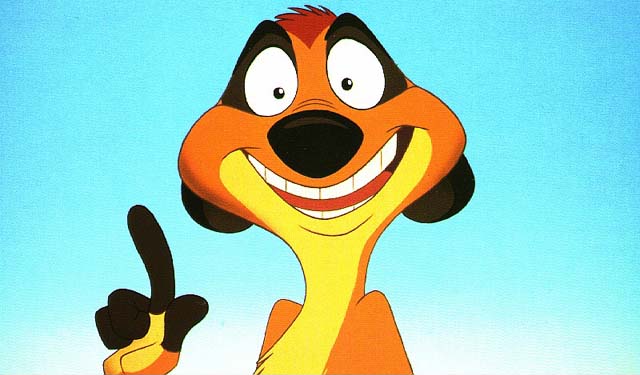
In one early scene, Timon the meerkat (voiced by Nathan Lane) tells his dad (voiced by Jerry Stiller) that he is leaving the meerkat colony. In response, Jerry Stiller – in that wonderful Jerry Stiller-like way – got emotional. He ranted, he raved, he howled to the heavens. In a flash, my mind leapt to all of Stiller’s great scenes as George’s dad on Seinfeld.

The cartoon wasn’t entertaining me, exactly, but I was pleased that it had triggered an entertaining memory.

Anyway, Stiller the meerkat did his yelling thing for quite a while. Timon listened. Then, when the dad finally stopped yelling and trailed off, Timon, heaving a heavy sigh, muttered, “Way to play to the cheap seats.”

I haven’t done it justice, but believe me, it was a great line. The timing was perfect. Lane’s delivery was perfect. The heavy-lidded look of disgust on Timon’s face was perfect. (Also, I was primed for a good joke as I was still reminiscing about Stiller’s antics on Seinfeld.)

In short, the quip caught me flatfooted. It killed me. I wheezed. I snorted. My “ha-ha ha-ing” rat-a-tat-tatted like a tommy gun. My laughter was even accompanied by the occasional, “Woo!”

I was quite a sight.

After I finally composed myself, I looked up to see all three of my charges staring at me with furrowed eyebrows.

“What is so funny?” Lauren, the middle child, asked. She was irritated by my amusement.

It was then that I realized that The Walt Disney Corporation had thrown an old guy a bone. It was almost as if, in that little, funny moment, the filmmakers spoke to me personally. “Listen,” they told me. “We know this movie isn’t nearly as good as The Lion King. We know you know that we’re phoning it in because this movie is direct-to-DVD and geared to babysit your kids. We also know that very few kids can tell a good cartoon from a bad one. Remember when you were a kid and Hong Kong Phooey was your favorite cartoon show? Have you seen a Hong Kong Phooey lately? See what we mean?”

I don’t know what I was thinking.

Then the filmmakers got to the heart of the matter: “That being said, we also understand that sometimes you’ll be forced to sit here against your will and watch this stuff. We do feel your pain. So here’s a joke just for you. Enjoy!”

I did, and I was grateful.

At the kids’ urging, I paused the video to explain the joke. I explained how the cheap seats for a play are far from the stage. I explained how an actor needed to unnaturally emote to get his point across to those folks way back there.

On it went. My remarks led to more questions, which I answered as best I could.

It turned out to be a very lovely chat.

Now I was doubly grateful: first, for the good joke, and second, for the thoughtful conversation the good joke spawned. I had also learned a lesson; I will never again so quickly pooh-pooh another cheap-Disney-direct-to-DVD-sequel-cash-in.

Hold on. Disney made a movie called Cinderella II?

Oh, I am going to murder someone.

Now let me open up the comments section by posing this question: What is your favorite “grownup” reference in a children’s movie?

Dishing Out Much More Than Eggs

Sometimes it takes a lot to get people to try new foods.

Being a fan of Dr. Seuss’ books is like saying you enjoy fun.

Pretty much the same thing goes for Green Eggs and Ham. It might not be your all-time favorite Seuss book, but it almost certainly ranks as one of your favorites. It definitely one of mine – and the illustration posted above is a big reason why. For those who haven’t looked at the book in a while (and shame on you all) this crash was the result of an oddly designed rail line. Instead of ending at a train station, this ride concludes with a Seussian ski jump over a lake.

What kills me, though, is just how blissed out everyone is. The captain, instead of thinking, “Hey! A TRAIN crashed into my boat!” wears an expression more in line with, “Hey! A FOX! How neat!”

The train engineer is happy. The passengers are happy. The goat, fox, and mouse are happy. The only guy who is less than thrilled is our finicky, black-hatted hero. He is troubled, though, not by the life-threatening crash but by the fact that Sam-I-am fails to notice that green eggs and ham look pretty nasty.

This illustration is all the more wonderful when one recognizes that Seuss’ rhymes don’t even begin to suggest any of this insanity. This is not an isolated incident. Earlier in the book Sam-I-am poses a seemingly benign question: “Would you? Could you? In a car? Eat them! Eat them! Here they are!” The statement, however, is accompanied by an illustration depicting a high speed, Sam-I-am-initiated hit and run.

Even more interesting is Black Hat’s reply: “I would not, could not, in a car.” Note that it is a simple, declarative statement. No exclamation point. So, yes, Black Hat is being rammed by a car, but that’s still no reason for him not to use his Indoor Voice.

Green Eggs and Ham is really a unique Seuss book in this regard; other Seuss books get as crazy this one, but the rhymes in those stories comment on and underline the action. Not here. It’s as if a train crashing into a boat is so commonplace in this particular Seussworld that it doesn’t deserve a mention.

And it doesn’t. Green Eggs and Ham is perfect just the way it is.