Doodle Do

superfly

When I was nine I decided to have a heart-to-heart conversation with my mother.

“I want to know how to draw,” I told her.

“You can draw. You draw all the time,” she replied.

“No. I want to know how to really draw,” I said. And Mom understood.

What I had been doing up to this point was filling one sketchbook after another with silly doodles – and, well, I was sick of it. My age was almost in the double digits. It was time to move to the next level. So I wanted Mom’s help (and Mom’s money) to become a real artist and create real things that looked really real.

Mom was very supportive of such things. She signed me up for lessons and, for the next eight years, I created some nice stuff. By the time I was 18, I was skilled in charcoal, watercolor, colored pencil, and oil – and was contemplating a career as a graphic designer. I assembled a portfolio good enough to get accepted into a design program at an excellent college.

Shortly after I unpacked my stuff in the freshman dorm, however, I discovered that I was sick of art. I’m not sure why this epiphany happened right after I paid my tuition bill, but it did; my new passion for playwriting had smothered the visual arts part of my brain.
pet peeve

I am a “finish what you start” kinda guy. That is to say, I am the kinda guy who understands that virtually nobody can earn a living as a playwright. I needed a fallback career, so I continued to stumble down the design path. I sleepwalked through my classes, rushed my studio projects, and hoped the professors would be in a generous enough mood to give me a low B. OK, a C was fine, too. Whatever. As long as I had time to write.

After I graduated, I worked as a designer for four years and life was very much the way it was when I was in college: My interest in design was half-hearted and my interest in playwriting nearly obsessive.

I got fired a lot.

Eventually I left design behind for good and found ways to write full time. What a relief that was. No more visual art. Occasionally, a family member (Dad) would ask why I don’t paint anymore.

“You were so good!” he’d say. Then he’d lead me to a wall. “Come here. Look at this painting you did. Isn’t it great?”

“You’re asking me to brag about my own stuff?” I’d ask.

“You should brag. Look at it!”

“Art no longer interests me,” I explained.

That, I discovered, was only half true. No, I have not touched watercolor paper or a canvas since college, but ever since I started writing for children, my zeal for doodling has returned with a vengeance. Thank goodness for that; I found that doodling can be an important tool for the children’s book writer.

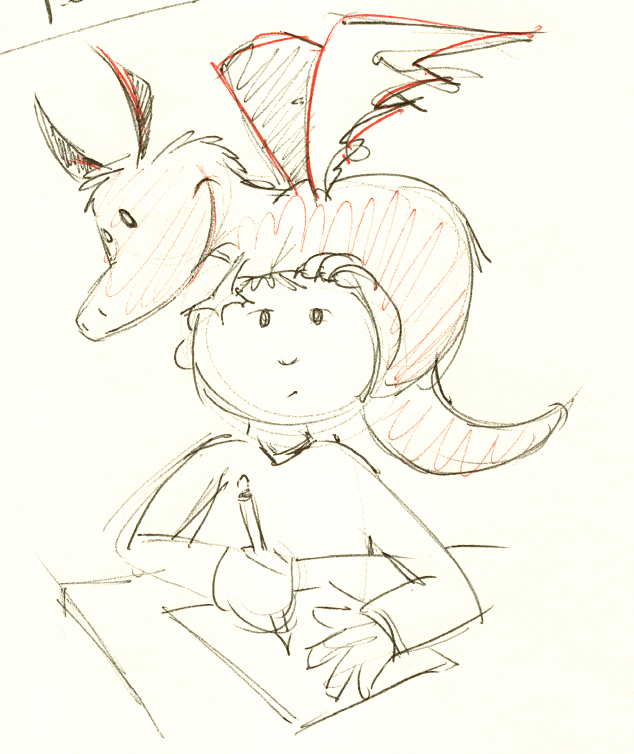
Doodling is great way to take a break from a story without really taking a break from a story. When I’m stuck or need a little motivation, I’ll often turn away from the computer and draw a character or a scene from the story I’m trying to tell. This helps me keep my mind on the task at hand. But since I’m exercising a different part of my brain, it’s refreshing, too. I’m working and taking a break at the same time. That’s multitasking!

I also recently noticed that doodling is a great way to generate new ideas – which turned out to be invaluable last November when I participated in my first Picture Book Idea Month (PiBoIdMo). Without giving too much thought to what I was doing, I filled up one sketchbook after another with weird characters and situations. Many of the drawings were just plain awful, but they suggested stories I never would’ve come up with had I relied solely on putting words on a page.

To put it another way, I found inspiration by becoming nine again.

Ta Daa!

The Age of Aquarium

dorypicThere are two types of writers: Music-Playing-In-The-Background Writers and Shaddap!-I’m-Writing! Writers.

For most of my professional career, I fell squarely into the Shaddap camp.

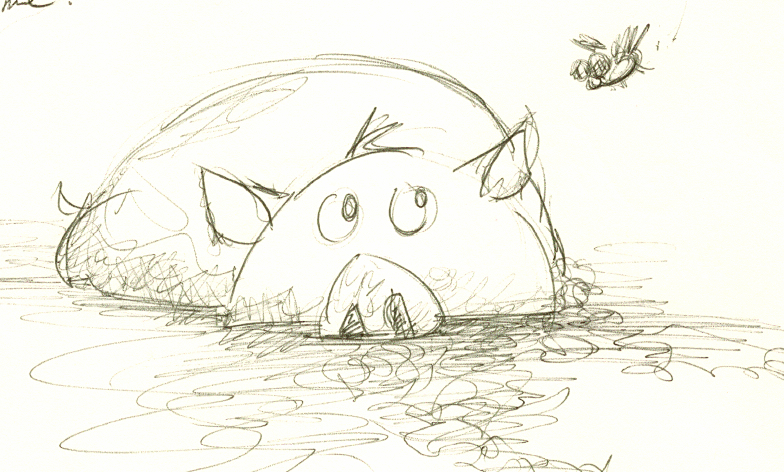
That’s not to say I can’t write with background noise. When I was a newspaper reporter, I was surrounded by it. I don’t think that environment prompted great writing, exactly, but I was prolific, and, once in a while, I’d come up with a story I was proud of. (I still love the articles I wrote about the nutty lady who kept pigs in her house.)

But the Shaddap writing philosophy was what I had always sought out.

Last summer, my employer moved me to a new building and, in it, a modern, glass-walled office. Working in what could be described as an aquarium would not have been my first choice – or even my 20th – but I adapted. (The installation of shades aided the adaptation process considerably.)

I even found ways to have fun in the new space; for example, I grew particularly fond of writing little witticisms on my glass door in marker:

Please do not feed the Editor. He is on a special diet of bacon and wine.

Glass, however, isn’t very good at muffling sound. And, unlike my days at the newspaper, I had difficulty tuning the noise out.

The noise I experienced in the newsroom, though loud, was always the same type of noise – a constant, dull, indistinct rumble of a half-dozen people simultaneously saying what sounded like “rhubarb” into telephones.

The noise in my new office was not constant, dull, or indistinct – so it could never quite morph into white noise. Every word I heard was crystal clear. What’s worse was that most of the words I was hearing were being uttered by teenagers:

“Ohmigod, did you hear what Cathy said to Kennedy when she saw her in the Math center?”

“Oh, my Gawd, I know!”

“She goes, she goes…”

“I know! I was, like, there! I was, like, ‘Oh, my Gawd!’”

Being distracted is one thing. Being distracted by this can cause physical pain.

So I converted. I am a Music-Playing-In-The-Background Writer!

My only challenge was figuring out a good musical fit.

The music needed to be bright and appealing, but couldn’t call too much attention to itself. So lyrics were out. I tried polka and bluegrass, but they were too toe-tappy. I discovered that Enya should not be listened to while either writing or operating heavy machinery. The Penguin Café Orchestra, a group I love, was a near miss; its songs kept me bright eyed, but prompted more humming than writing.

And then, success!

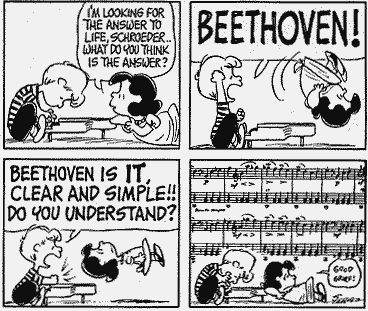
SchroederGod bless the beautifully bombastic Beethoven. I’ve always been fond of the fellow, but never more than now. His tympani and brass cancels out every trace of teen angst loitering outside of my door. What’s more, his music keeps me more alert and energized. So that’s one less cup of coffee I need every day.

Thanks to this fine composer my new office suits me just fine.

So powerful was his impact, I now play my old Beethoven LPs when I write at home. The music hasn’t improved my productivity much there, but it has made me more polite. After all, when Beethoven is on, I no longer need to shout “Shaddap! I’m writing!” to my loved ones.

Do you listen to music when you write? If so, which artist gets your creative juices flowing? (Feel free to post YouTube links in the comments.)

A Tale of Two Driveways

I used to live next door to a guy who owned a snowblower the size of a French automobile. His name was Russ and he thought I was an idiot.

“Woo! Look at all the snow,” he announced to the world at large as he stepped out onto his side porch. The neighborhood was empty, save for me wielding my blue plastic shovel. Russ figured I was a better audience than nobody.

“Mike. Mike. Mike. What do you think? Ten inches? Twelve?”

“Seven, maybe,” I replied as I paced back and forth pushing my shovel. Talking about the weather was no reason to pause in my work — especially if the person I was talking to was Russ.

“Seven? No! Ten. Probably 12 or 13,” he corrected me. “Hey. Once I’m done with my snowblower, you can use it.”

I kept shoveling. “No, thanks.”

“Really?! You’re gonna break your back doing…that…when my snowblower could do your whole driveway in five minutes?”

“I like to shovel.”

Russ snorted. “Suit yourself,” he said. The tone of his “suit yourself” could only be interpreted one way: “Suit yourself, you idiot.”

Then Russ went back inside his house. He still had to throw on a light jacket to prepare for his snowblowing adventure. Sure it was 20 degrees, but there’s no need to bundle up for  a job that takes only five minutes.

Although I would never have accepted anything from Russ, I was being honest with him. I enjoy shoveling. It’s quiet. Nothing is better at deadening noise than a fresh blanket of snow and, when I am out there, I hear little more than my shovel scraping along the asphalt. I’ve grown to find the sound lovely — not because it is an intrinsically appealing sound, but because I associate it with an appealing state of mind.

I also refuse the offers of well-meaning neighbors wielding leafblowers. Raking works for me in very much the same way shoveling does. Both tasks require a certain degree of focus but are freeing enough to let your mind wander or, in my case, go pleasantly, refreshingly blank.

That quiet mind, I’ve discovered, is often the lull before a creative storm; when I finish shoveling and get back to work, I am rarely more productive. My brain is rested and ready to go, my ideas flow with little effort, and my happiness is total.

On this particular snow shoveling day, however, my mind couldn’t get as blank as I would’ve liked. I was still delighted, however. For there, woefully underdressed and cursing under his breath, was Russ failing to get his snowblower started.

I couldn’t help myself.

“Want to borrow my shovel?”

“No!” Russ spat as he gave the cord its 20th white knuckled pull.

I wanted to say “suit yourself,” but I couldn’t do it. It is such a smug and jerky phrase, isn’t it? Regardless, I entered my house with a happy heart. I had just shoveled seven or maybe 13 inches of snow. I felt useful, rested, and vaguely fit. Better yet, I could see a pot of coffee and an afternoon of inspired writing in my immediate future.