
The Prose Poseur

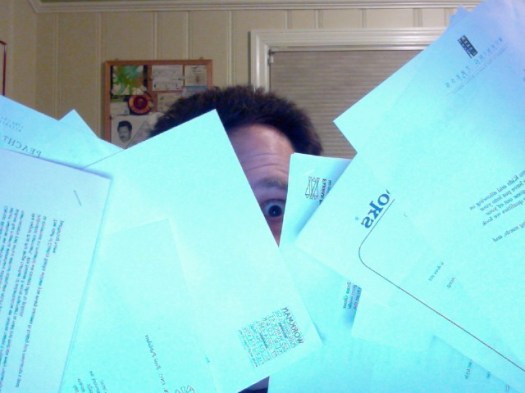
They don't give these mugs to just anybody! (Thanks again, Sarah W!)
They don’t give these mugs to just anybody! (Thanks again, Sarah W!)

I went to my first children’s book critique group in 2006 at a local Borders Books & Music. Arriving with a few copies of my manuscript in hand, the group welcomed me with open arms. Better still, the critique I received that night was positive and thoughtful enough to give me a lot to chew on after things broke up. I was jazzed and energized. I wanted to get started on a revision right away.

So instead of going home, I set up shop in the café to slurp a latte and edit. I was working there for about 15 minutes when I noticed someone watching me. The woman, let’s call her Becky, was a member of the critique group. She had not brought a story, so I had no idea what kind of a writer she was. I did know, however, that she wasn’t a very good critiquer; her comments that evening were unfocused, benign, and across-the-board positive. At the time, I had pegged her as the type of person who went to great lengths to avoid conflict.

Right away her presence in the café struck me as peculiar. It had been 15 minutes since the meeting broke up and I was seeing her only now. She also seemed to have no intention of buying anything.

So when our eyes met it wasn’t an “Oh, hey, you needed a coffee too, eh?” kinda vibe. It was a bit more like a stalking. Not a legit, creepy one – instead, her stalking attempt was a lot like the way she critiqued my story: unfocused and benign.

Because I had noticed her, I had forced her to be social. “Oh, hi! I really liked your story. Really liked it.” she said as she approached the table.

“Thanks,” I replied.

“I was planning to have something to show for this meeting but I just couldn’t get around to it. I just couldn’t find the time.”  

“That can be tough sometimes.”

She nodded. She looked at her feet. Then Becky said, “Can I talk to you a minute?”

I did not want to talk to her for a minute. I had three reasons why:

The first reason was purely selfish; I wanted to revise my manuscript without interruption.

The second reason was because of the weirdness of this encounter; I wasn’t threatened by her stalkingishness, but I was uncomfortable with it.

The third and most important reason was that no one who asks, “Can I talk to you a minute?” ever follows it up with something you want to hear. Never. Ever.

But it’s almost impossible to say no to a “Can I talk to you a minute?” On its face it’s such a minor request, isn’t it? A minute? Anyone can spare a minute, right? What are you, some kind of selfish jerk? And even if you are a selfish jerk, do you really want to telegraph your jerkiness by saying no? And if you do say no, you then have to follow it up with more than a minute’s worth of lame reasons why you said no and, well, that’s just opening up a whole new can of worms.

So she said, “Can I talk to you a minute?” and I said, “Sure.”

So Becky began. “To be completely honest, I really do have time to write,” she said. “I just can’t. At night, after the kids are in bed, I pick up a book and read. For hours. I know I should be writing, but I don’t. I know I’ll hate myself if I don’t write, but I still don’t. I’m like, ‘Just one more chapter and then I’ll write.’ But then I go ahead and read another chapter and another chapter until it gets too late to get started. Then I feel guilty that I didn’t write and I go to bed hating myself. So I say, ‘I’ll do it tomorrow. I’ll write tomorrow.’ But then tomorrow comes and I do the same thing. I spend another night reading or watching TV or whatever.”

Her story went on for much longer than what I wrote here – a lot longer than a minute – but the above is the gist of it: procrastinate, guilt, repeat.

The two of us had been there together for about 20 minutes before she finally lobbed a question in my direction.

“What should I do?” she asked.

By the time this question came my way, I was fed up with Becky. I would’ve killed to have the amount of time she had to write. Not only did she squander this precious time night after night after night, but at this moment she was squandering my time, too.

So I said, “What should you do? Here’s an idea. Write something. Either that or acknowledge that you’re not a writer. From what I’m hearing, it sounds like you just like the idea of being a writer.”

It was as if I punched her in the face. And, in a way, I suppose I had.

Immediately I tried to soften my view without abandoning it. “Writers don’t have to be published or anything,” I went on. “But they do need to have a fire, you know, a desire to write. Do you have that?”

“Yes, I do!” she hissed, summoning a rage that I didn’t think she had in her. “I know I do because I want my name on book more than anything!”

That didn’t answer my question, but at that point, the answer would suffice, thank you. Whatever ended it.

Things wrapped up quickly after that. As she stormed out, Becky vowed to have a story to be reviewed next month and I was left alone. I had a knot in my stomach and was too ashamed of my jerkiness to focus on my story. The evening was a complete wash.

Becky didn’t show up to the next critique meeting. In fact, I never saw her again. A big part of me feels terrible about stomping on her dreams. They may have been pipe dreams, but they were hers and I had no right to lace up my hobnail boots.

Another part of me, however – the part that’s seven years older and enjoys forgiving myself – wonders if I might have done her a favor. Maybe that fateful night she learned something about herself. Maybe my actions gave her permission to enjoy her evenings without guilt. Maybe, after she puts the kids to bed, she can read and watch TV in peace, knowing who she is. There’s no shame in not being a writer. Quite the opposite, really.

Then, once in a while, I imagine that what I said was the kick in the butt that prompted Becky to act. Maybe she writes now. Maybe she found a new group. Maybe she’s published. Maybe I did a good and noble thing.

And maybe I have a few pipe dreams in me, too.
How I Found Inspiration in Baltimore

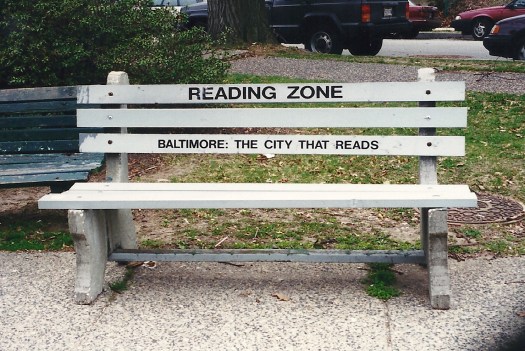
What, no book? Then scram!
No book? Then scram! Benches are for readers.

I am not a fan of cocktail parties. I just don’t understand why I need to dress up in a suit in order to drink wine. Yet, every year I am tossed headlong into the Cocktail Party Lifestyle. I am a member of The Council for the Advancement and Support of Education (CASE) and I am expected to attend the organization’s annual district conference.

I’m a bit of a black sheep at these things for more reasons than my dislike for cocktail parties, however. For one thing, CASE conferences mostly cater to college representatives; I represent a secondary school. Also each college usually sends a brigade of representatives (aka a built-in group with whom to socialize at cocktail parties); I attend these thing alone.

But don’t get me wrong. I like CASE conferences. There are usually a lot of interesting workshops to attend and the food is always excellent. And, because a person would look pretty stupid drinking wine in a suit at a Red Roof Inn, the CASE event organizers always  select a beautiful hotel – the kind with one of those cavernous lobbies that you’d “ooh” and “aah” over if you weren’t so focused on looking sophisticated in front of the bellman.

So the conferences are great.

But as soon as the sun goes behind the yardarm – or whatever it is those Ivy Leaguers like to say – the bar opens and the beautifully suited people start getting tipsy in front of their work spouses. That is my cue to go to my room, watch TV, and enjoy the splendid isolation that I can rarely get anywhere else.

See how great the conferences are? I learn a lot, I eat well, and I can nurture my inherent loner instincts.

In the days leading up to last year’s Baltimore Conference, however, my usual anticipation was replaced with grumpiness. The reason was my writing. I didn’t have writer’s block; it was more like “writer’s meh.” That is to say, I was writing, but not all that well. At times the quality of my prose bordered on the craptacular.

I plugged away, however. Every night I would seal myself up in my office and work like a dog, but the results were always pretty much the same. I found the pattern so vexing that, in a fit of pique, I made a grim promise to myself: I will spend every moment of my coveted CASE Conference Evening TV Time writing. By the end of the conference weekend I vowed to have a solid picture book draft.

Normally I compose all my stories in my home office on my computer. I don’t own a laptop or an iPad, so to fulfill the promise I made to myself I would have to write my story using pen and paper. I’ve never done that before; I use pen and paper all the time, but only for notes, doodles, and story outlines. Another concern: I would be writing in an unfamiliar hotel room. Would the room be comfortable enough to write? Would it be too comfortable? I spent a lot of time finding that comfort balance in my home office and was doubtful I would find the same balance in Baltimore.

But what was done was done. I made a vow. I’d have to try.

So I checked in and kept the “oohs” and “aahs” to myself because I am a Sophisticated Traveler. Then I put on a tie and attended the workshops on How To Build a Better Alumni Magazine. As the speakers droned on, my colleagues and I took copious notes.

“Focus groups,” my colleagues tapped on their iPads.

“A story about a rat,” I wrote on my notepad.

“Increasing circulation,” my colleagues tapped.

“Named Scampers,” I wrote.

“Utilizing your strategic plan,” they tapped.

“Scampers and the Scientific Method,” I scribbled. Now that’s a darn good title.

On it went. By the time that yardarm expression was being bandied about, I had my story outline and was heading – more like sprinting – to the elevator to get down to business.

I peeled off my suit and donned some comfy sweats. Then, to my amazement, I watched my pen fly.

The new environment and the new method of writing I was so worried about didn’t impede the creative process at all. It invigorated me. It was the shot in the arm I had been searching for.

It was then I remembered Einstein’s definition of insanity: doing the same thing over and over again and expecting different results. Every evening I had been writing away without success in my home office. What I should’ve been doing was looking for a way to change things up. Baltimore and a ballpoint pen was change enough. I was dumbfounded by how prolific I was.

By the time I finished the first draft, my stomach was filled with happy little butterflies. I was giddy.

Without pause, I burrowed into my second draft. That draft was accompanied by calisthenics of a sort. I paced the room, I read rat dialogue aloud as if I was a Shakespearian actor. I spun around in the desk chair with delight.

When I was done, I was starving. I had been working without a break for hours.

“I deserve a drink,” I said aloud to myself.

Myself agreed.

Without pause, I grabbed my CASE conference ID tags and headed for the exhibitor room, where the cocktail party was being held.

I was the only attendee wearing sweatpants. I also was the only attendee without shoes – because I (correctly) assumed that the journey down to the party would be entirely carpeted.

To their credit, the wait staff made its best effort to ignore me, but I had no trouble flagging down a glass of Chianti and a giant handful of bacon-wrapped shrimp. I munched and imbibed and trembled with joy.

Then, as I stood there alone, rumpled and shoeless, and looking, I presume, like a hobo who wandered into Gatsby’s West Egg home, I decided that cocktail parties weren’t that bad after all.

My Second Repost: My Rejection Collection

It's like that scene at the end of Miracle on 34th Street, only depressing.
It’s like that scene at the end of Miracle on 34th Street, only depressing.

Is it really a “repost” if said post is from so long ago you haven’t read it before?

Yes. Yes it is.

Sorry about that. On the upside, it will appear new to you, and isn’t that the important thing?

Enjoy!

***

A few years ago, an aspiring writer acquaintance of mine decided to share his feelings with me. Just that afternoon he had received a rejection letter and he was, to put it mildly, miffed. The editors at the publishing house were stupid, he said. And someday he would show them just how stupid they were. He would keep this rejection letter and file it away. Then he would rub that letter in their stupid, stupid faces when he was a big success.

My first thought upon hearing this monologue was, “Should such an angry, spiteful person be writing for children?”

I decided not to share that particular thought, though. Instead, I told him that I, too, keep a careful list of every rejection I ever received ­– which is true. (What I didn’t tell him was that my list exists for professional reasons rather than personal ones. I use it to avoid accidentally sending an editor a manuscript she has already rejected.)

On another occasion, I listened to another aspiring writer explain her state of mind upon receiving her own rejection letter. Her emotions ran the gamut from self-pity to self-loathing.

My first reaction to her was, “Why is this person writing at all? It’s killing her.” And, yes, I kept this thought to myself, too.

While both of these writers’ reactions were outwardly quite different, they were similar in two significant ways: First, their responses were strongly emotional, which ­is exhausting. (My philosophy is, if you must to do something to exhaust yourself, at least let it work your core.) Second, both writers found it necessary to understand and articulate the reason why they were rejected.

There can be hundreds of reasons why your story gets rejected, so fretting about why, in my view, is a waste of time. That said, if you must have an explanation to put a painful rejection behind you, my advice is to refrain from blaming either the editor or yourself (which, as I mentioned earlier, will prompt strong emotions, is exhausting, and does not count as exercise). Instead, choose a reason that involves math: The odds are against you.

Never forget that thousands of wannabes are vying for maybe a dozen available slots on a publisher’s list. There’s a reasonable chance that you’ll never get the brass ring, no matter how good you are. It stinks, but it’s true. The best part about using this particular rejection explanation is that it is – at least on some level – always correct.

So now that you have your reason, get back to work. ‘Cause there’s no chance you’ll ever get published if you don’t write and send stuff out. Being dogged is the only way to tilt the odds a bit more in your favor.

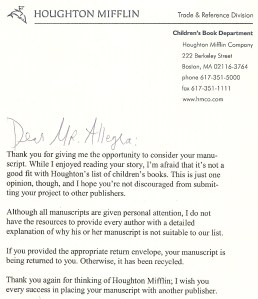
My very first children's book rejection letter. Ah, memories!
My very first children’s book rejection letter. Ah, memories!

For the purpose of this post, I did something I had never done before ­– counted up all the children’s book rejections on my list. I once heard that Dr. Seuss accumulated as many as 43 rejections before his first book, And to Think That I Saw It on Mulberry Street, was published. That’s a good number, but I knew I had it beat. I guessed that my rejection total would be around 75.

I wasn’t even close. It was 114.

It gets better. I once received a rejection a day for three consecutive days – an event I found so impressive that I had to mention it on Facebook. “Never before,” I wrote, “have I been so successful at failing.” My friends offered me hearty congratulations on my achievement. A few of them even encouraged me to beat this record. (I did not disappoint; a few months later I got three rejections in two days. So WOO!)

Needless to say, if I got upset every time one of those letters arrived, I would have given up this writing thing a long time ago.

This past September I offically became a Published Author. It is my sincere hope that this fact will help me get my second book accepted a bit faster than the first one. If it doesn’t, however, I won’t fret too much; fretting is exhausting and I really should be working on my abs.