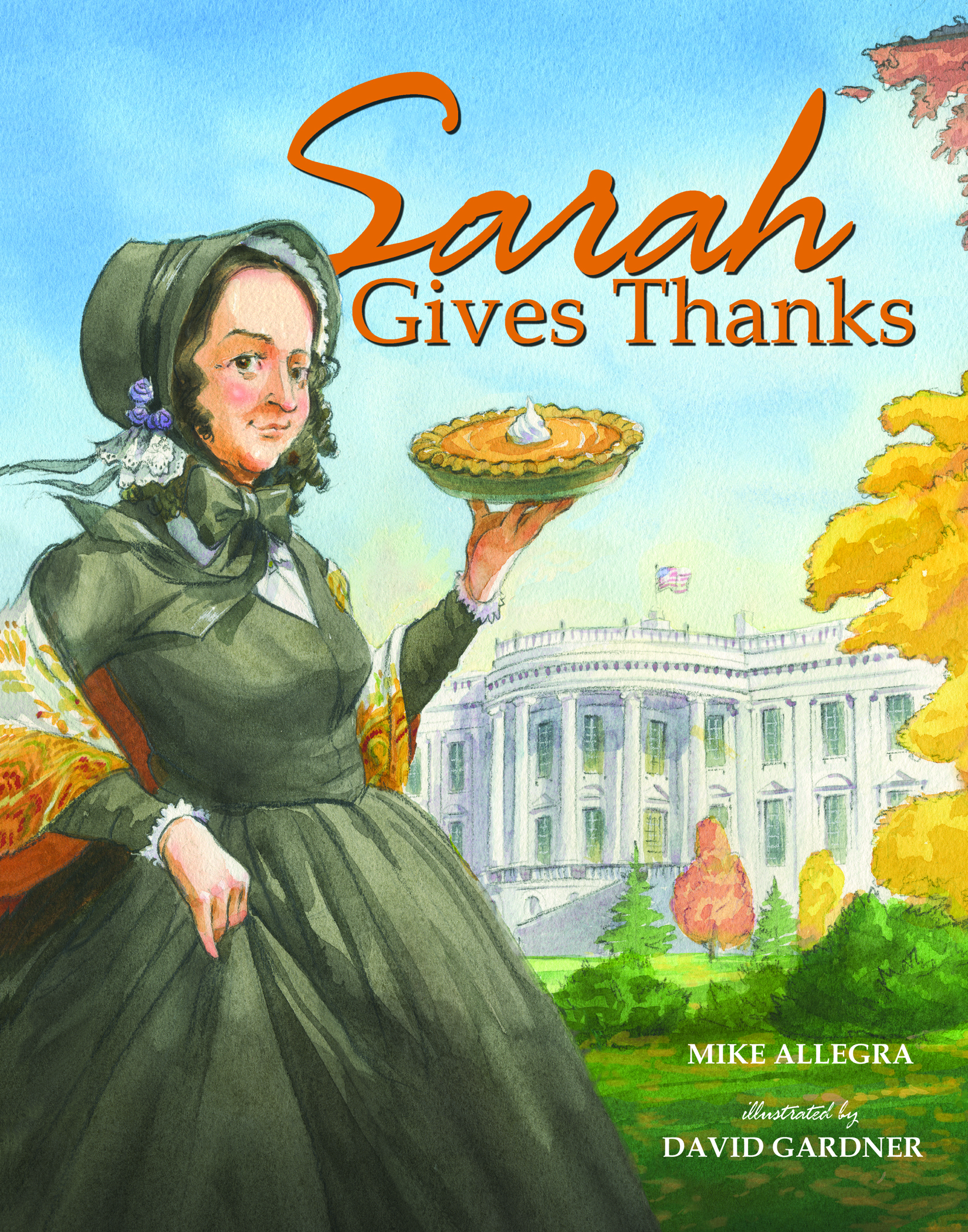
I am delighted to report that the charming and talented David Gardner has posted some Sarah Gives Thanks illustrations online. Check ’em out here.

A groovy little website by children's book author Mike Allegra
I am delighted to report that the charming and talented David Gardner has posted some Sarah Gives Thanks illustrations online. Check ’em out here.

Anyone who knows me knows I love goats. I love the fact that goats in the Middle East climb trees and hang out on the spindly branches like overripe fruit. I love the fact that they are escape artists; no matter how high the fence, a goat will, sooner or later, find herself on the other side of it. I was even charmed by the goat I met recently who – a little too casually – stood near the front gate of a petting zoo; in a flash, she snatched and ate my admission fee before I could hand it over to the guy in charge.
Goats are friendly, curious, whip-smart, independent, and have an ornery streak that commands respect. (All the animals I really like, with rare exceptions, are ornery herbivores.) So goats are the complete package.
I don’t own any goats, I’m afraid, as I don’t have enough property to keep them. That will change someday. In the meantime, when I need my fix, I frequent area farms, find a goat, and scratch her chin. I find this oddly relaxing and the goat likes it, too.
My point is I’ve studied a lot of these little buggers. One thing I’ve noticed is that when you look at a goat head on, it appears kind of simple. The reason has to do with its eyes, I think; they’re widely spaced and those unusual, rectangular pupils make them look a little walleyed.
But when a goat turns its head a little to get a better look at you, that simple face suddenly radiates what I can only describe as wisdom – for only when a goat offers her profile can you see that wonderful, enigmatic Mona Lisa smile.

A few years back, an aspiring writer acquaintance of mine decided to share his feelings with me. Just that afternoon he had received a rejection letter and he was, to put it mildly, miffed. The editors at the publishing house were stupid, he said. And someday he would show them just how stupid they were. He would keep this rejection letter and file it away. Then he would rub that letter in their stupid, stupid faces when he was a big success.
My first thought upon hearing this monologue was, “Should such an angry, spiteful person really be writing for children?”
I decided not to share that particular thought, though. Instead, I told him that I, too, keep a careful list of every rejection I ever received – which is true. (What I didn’t tell him was that my list exists for professional reasons rather than personal ones. I use it to avoid accidentally sending an editor a manuscript she has already rejected.)
On another occasion, I listened to another aspiring writer explain her state of mind upon receiving her own rejection letter. Her emotions ran the gamut from self-pity to self-loathing.
My first reaction to her was, “Why is this person writing at all? It’s killing her.” And, yes, I kept this thought to myself, too.
While both of these writers’ reactions were outwardly quite different, they were similar in two significant ways: First, their responses were strongly emotional, which is exhausting. (My philosophy is, if you must to do something to exhaust yourself, at least let it work your core.) Second, both writers found it necessary to understand and articulate the reason why they were rejected.
There can be hundreds of reasons why your story gets rejected, so fretting about why, in my view, is a big ol’ waste of time. That said, if you must have an explanation to put a painful rejection behind you, my advice is to refrain from blaming either the editor or yourself (which, as I mentioned earlier, will prompt strong emotions, is exhausting, and does not count as exercise). Instead, choose a reason that involves math: The odds are against you.
Never forget that thousands of wannabes are vying for maybe a dozen available slots on a publisher’s list. There’s a reasonable chance that you’ll never get the brass ring, no matter how good you are. It stinks, but it’s true. The best part about using this particular rejection explanation is that it is – at least on some level – always correct.
So now that you have your reason, get back to work. ‘Cause there’s no chance you’ll ever get published if you don’t write and send stuff out. Being dogged is the only way to tilt the odds a bit more in your favor.
For the purpose of this post, I did something I had never done before – count up all the children’s book rejections on my list. I once heard that Dr. Seuss accumulated as many as 43 rejections before his first book, And to Think That I Saw It on Mulberry Street, was published. That’s a good number, but I knew I had it beat. I guessed that my rejection total would be around 75.
I wasn’t even close. It was 114.
But wait, it gets better. I once received a rejection a day for three consecutive days – an event I found so impressive that I had to mention it on Facebook. “Never before,” I wrote, “have I been so successful at failing.” My friends offered me hearty congratulations on my achievement. A few of them even encouraged me to beat this record. (I did not disappoint; a few months later I got three rejections in two days. So WOO!)
Needless to say, if I got upset every time one of those letters arrived, I would have given up this writing thing a long time ago.
This September, I will officially be a Published Author. It is my sincere hope that this fact will help me get my second book accepted a bit faster than the first one. But if it doesn’t, I won’t fret over it; fretting is exhausting and I really should be working on my abs.
 Hey, Look! A Writer Fellow!