My Second Repost: My Rejection Collection

It's like that scene at the end of Miracle on 34th Street, only depressing.
It’s like that scene at the end of Miracle on 34th Street, only depressing.

Is it really a “repost” if said post is from so long ago you haven’t read it before?

Yes. Yes it is.

Sorry about that. On the upside, it will appear new to you, and isn’t that the important thing?

Enjoy!

***

A few years ago, an aspiring writer acquaintance of mine decided to share his feelings with me. Just that afternoon he had received a rejection letter and he was, to put it mildly, miffed. The editors at the publishing house were stupid, he said. And someday he would show them just how stupid they were. He would keep this rejection letter and file it away. Then he would rub that letter in their stupid, stupid faces when he was a big success.

My first thought upon hearing this monologue was, “Should such an angry, spiteful person be writing for children?”

I decided not to share that particular thought, though. Instead, I told him that I, too, keep a careful list of every rejection I ever received ­– which is true. (What I didn’t tell him was that my list exists for professional reasons rather than personal ones. I use it to avoid accidentally sending an editor a manuscript she has already rejected.)

On another occasion, I listened to another aspiring writer explain her state of mind upon receiving her own rejection letter. Her emotions ran the gamut from self-pity to self-loathing.

My first reaction to her was, “Why is this person writing at all? It’s killing her.” And, yes, I kept this thought to myself, too.

While both of these writers’ reactions were outwardly quite different, they were similar in two significant ways: First, their responses were strongly emotional, which ­is exhausting. (My philosophy is, if you must to do something to exhaust yourself, at least let it work your core.) Second, both writers found it necessary to understand and articulate the reason why they were rejected.

There can be hundreds of reasons why your story gets rejected, so fretting about why, in my view, is a waste of time. That said, if you must have an explanation to put a painful rejection behind you, my advice is to refrain from blaming either the editor or yourself (which, as I mentioned earlier, will prompt strong emotions, is exhausting, and does not count as exercise). Instead, choose a reason that involves math: The odds are against you.

Never forget that thousands of wannabes are vying for maybe a dozen available slots on a publisher’s list. There’s a reasonable chance that you’ll never get the brass ring, no matter how good you are. It stinks, but it’s true. The best part about using this particular rejection explanation is that it is – at least on some level – always correct.

So now that you have your reason, get back to work. ‘Cause there’s no chance you’ll ever get published if you don’t write and send stuff out. Being dogged is the only way to tilt the odds a bit more in your favor.
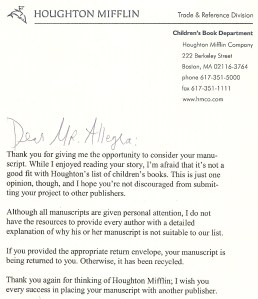
My very first children's book rejection letter. Ah, memories!
My very first children’s book rejection letter. Ah, memories!

For the purpose of this post, I did something I had never done before ­– counted up all the children’s book rejections on my list. I once heard that Dr. Seuss accumulated as many as 43 rejections before his first book, And to Think That I Saw It on Mulberry Street, was published. That’s a good number, but I knew I had it beat. I guessed that my rejection total would be around 75.

I wasn’t even close. It was 114.

It gets better. I once received a rejection a day for three consecutive days – an event I found so impressive that I had to mention it on Facebook. “Never before,” I wrote, “have I been so successful at failing.” My friends offered me hearty congratulations on my achievement. A few of them even encouraged me to beat this record. (I did not disappoint; a few months later I got three rejections in two days. So WOO!)

Needless to say, if I got upset every time one of those letters arrived, I would have given up this writing thing a long time ago.

This past September I offically became a Published Author. It is my sincere hope that this fact will help me get my second book accepted a bit faster than the first one. If it doesn’t, however, I won’t fret too much; fretting is exhausting and I really should be working on my abs.

A Natural Cure

I saw what you did to that cat and, well, I just wanted to thank you. I also want a peanut.

I love the idea of sitting in an Adirondack chair on a sunny day with a pad and a pen. There’s something so romantic, so wonderful about writing in nature.  So, once in a while, I give it a try.

And then the pollen goes up my nose. And the bugs bite. And the sun get too hot and my hands get sweaty, and, since I’m a lefty, I smear the ink with my sweaty hand – which is not such a big deal because I’m not writing anything worth keeping anyway, because every time a leaf crinkles, I look up in eager anticipation of finding that feral cat that I oh, so wanna hit with a rock because NO ONE menaces my squirrels without hearing from me, buddy!

Ahem.

So I guess what I’m saying is that, when I try to write in it, nature distracts and annoys me.

Otherwise nature and I have no real problems. It often delights me. When the weather is right, I could stand around in nature all day interacting with it in the most genial and stupid ways. For example, the other day I caught myself waving at a squirrel. He didn’t wave back – that would be asking too much, I suppose – but he did seem to take the gesture in the spirit in which it was given and that pleased me no end.

Better still, I have discoverd that actions such as these improve my writing.

I have the bad habit of chaining myself to my desk. Even when my brain refuses to work, I stay put. In general this could be defined as good self-discipline. You can’t just sit around and wait for the muse, after all. It never shows up when you want it to. Since the words aren’t going to write themselves, I muscle through.

But every writer reaches a point when good self-discipline evolves into something that looks a whole lot more like masochism. Nothing’s gonna come no matter how hard you try.

So I pry myself away and tell myself it’s not procrastination if I deliver myself back to the desk eventually. Then I take a walk and wave at squirrels. Doing so restores my overall sense of well-being. It provides the second wind I need to get back to my awful, awful writing and make something that at least resembles progress.

Better yet, such a walk allows me to pursue my new hobby: feral cat chasing. In the grand scheme of things, saving a squirrel is always more important than a well-written paragraph.

Three Things Every Author Should Know about School Visits

This many! (Fun fact: This photo shoot took A LOT longer than it should have.)

Have you ever been on the move for so long that once you finally stop moving, you don’t know what to do with yourself?

I feel that way now. For the past several weeks I had gotten into the habit of running from one place to another, talking about my book, coming home, and then collapsing in a heap. It was exhausting. It was also exciting and new and it made me feel very, very important. I really did love it. I loved it more than I thought I would.

Now that it’s all over, I’m suffering a little from promo withdrawal.

But my schedule, exciting as it was, didn’t allow me to write at all. So I am very eager to reacquaint myself with my first love. I missed writing much more than I liked feeling important.

During the tour I visited lots of schools. That is par for the course for a picture book – especially a nonfiction one. Now that I’ve had a little time to reflect on those visits, I’d like to share three takeaways:

1. Kids love to take you down rabbit holes.  

During one class visit I told a group of 40 third graders that my fondest childhood Thanksgiving memory was watching Big Ape Movies on the local TV station. Every single year the station aired Mighty Joe Young, King Kong, and Son of Kong. “Six straight hours of simian mayhem!” I announced. “I have no idea what giant gorillas have to do with Thanksgiving, but, hey, who cares? It’s wonderful!”

And by opening that door, I invited in a long string of ape-related questions. Clearly I was the King Kong expert these kids had been waiting for their whole lives. “How big was he?” one asked. (I guessed about 50 feet tall.) “Did that big building get damaged bad?” (No, they just needed to patch up some bullet holes.) Would King Kong win a fight with Godzilla? (If Americans made the movie, I replied, then yes.)

It was a blast. And, because I indulged this line of questioning, the kids loved me. Oh, and my “simian mayhem” line made one teacher to do a spit take; this is perhaps my proudest achievement ever.

2. There’s one teacher in every school who assumes you don’t know what you’re doing.

This teacher is the wet blankie who tries to calm down the children after you have invested so much time and energy revving them up. Not. Cool.

This teacher is either very, very young and well-meaning or one of those old law and order types who is one year away from retirement. (Teachers with tenure and more than a few years of full time work left in them are happy to sit back, drink coffee, and let you do your thing.)

I find it important to address the interrupting teacher directly. Doing so is a bit of a tightrope walk, however, for I have to communicate two messages at the same time. My first message is for the kids: “Your teacher is the boss. Your teacher is even MY boss and it is important to always do what she says.” My second message is for the teacher and is rich with subtext: “Why don’t you follow the fine example of your peers and drink some coffee?”

At one of my recent visits, a young teacher, trying to be helpful, inserted herself into my presentation to “calm things down, a bit.”

In front of the crowd I told the teacher she made an excellent point. Then I thanked her. Then, before the teacher could say anything else, I called on an earnest little girl who  could be counted on to ask a question that was “appropriate.” As the girl asked her question, the teacher and I chatted to each other with our eyes.

“I got this,” my eyes told her.

“You sure?” her eyes asked back, concerned.

“Your coffee is getting cold,” my eyes replied. “And that chair waaaay over there looks hella comfortable.”

3. Controlling a Q&A session is a lot easier than you might think. 

Kids wear their personalities on their sleeves. Even if they say nothing, their body language makes it easy to differentiate the silly from the studious. You don’t need talent to figure out who’s who. You just need eyes. Anyone can do this. Really. Anyone.

By using this information, I became a Q&A conductor of sorts; I called on the sillies when I wanted to dial up the energy in the room and the studiers when I wanted to dial it back.

And because I love and respect teachers and don’t wanna make their jobs any more difficult than they already are, I wrapped up all my Q&A sessions by calling on three studious students in a row. You’re welcome, teachers. Here’s hoping I’ll see you again next year!