A Seat at the Table

Festive!

Once upon a time, most of my extended family lived within a few miles of each other. If your family is fun, I recommend this. My childhood holidays were, without fail, happy and lively affairs.

Different relatives divvied up hosting duties. My Auntie Susan covered Easter. Grandma Dacey covered Christmas. And Thanksgiving was hosted at our house, under the ruthless supervision of Mom. When I was a kid, Mom didn’t trust me to do anything that involved cooking—which was wise—so she did everything herself. My role was to be on call for assorted bits of unskilled labor.

“Get the big bowl. You know the one,” Mom yelled over the roar of the hand mixer.

I reached for a bowl.

“No, not that bowl. The big bowl.”

I reached for a big bowl.

No, the other big bowl. The yellow one. It’s in the lower cabinet.”

I reached for the cabinet knob.  

“The other lower cabinet. To your left. Your other left. No! Look! Look where I’m pointing. Am I pointing there? Really? You think I’m pointing there?! Then I’m going to tell Santa to get you a trip to the eye doctor because I’m not pointing anywhere ne— Oh, for God sakes! Never mind, I’ll get it!”

Then Mom ordered me out to set the dining room table.

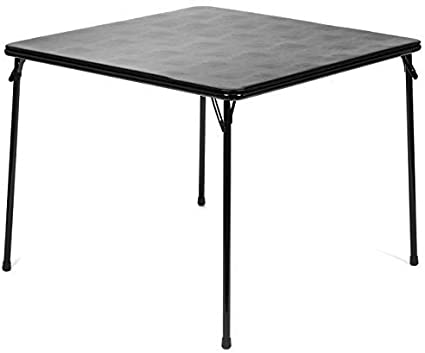
Our dining room table was large under any circumstances, but grew to mammoth proportions after I locked the two wooden leaves into place. It still wasn’t nearly big enough to accommodate all the relatives, however, so Mom sent me to fetch the card table. This I would wedge against the end of the real table to make one, super long mega-mammoth table. The seats around this hasty addition were reserved for the youngest in the family: Cousin Celeste, Cousin Jason, and me.

And oh, how I hated sitting there. Not because of Celeste or Jason; I loved talking to those two. It was the crummy table, which was shorter and wobblier than the Real Table. Sitting there made me feel like a second-class citizen.

It was a classic case of the Haves and Have-Nots. The adults, the Haves, had a nice cherry wood table from Ethan Allen with matching chairs that were both stately and comfy. They had a real tablecloth, that is to say it was actually made from some kind of cloth. They used the good China and the real silverware.

Celeste, Jason, and I , on the other hand, sat our skinny butts on folding chairs; rested our elbows on one of those crinkly, papery, plastic-y table cloths; and ate on and with the same crummy dishes and flatware that I used every ding-dang day.

So I seethed with outrage.

This was my house, too, I reasoned. Shouldn’t I have a spot at the Good Table? Heck, Mom made me polish the silverware. Shouldn’t I at least be stabbing my turkey with a classy fork?

Year after year, I took my meals in the culinary ghetto. By the time I turned nine I had had enough. I begged Mom to find me a spot at the Good Table.

“There’s no more room,” she replied.

“I could switch spots with someone!”

“Who?”

“Dad!” I announced. It seemed logical. Dad was clumsy, slow, and weirdly passive aggressive about performing household chores; he always found a way to screw them up somehow. Dad was totally a card-table guy.

But Mom was unconvinced. She was Old School; to her way of thinking, a kid could never, ever, in any way, outrank an adult—even if the adult in question just brought home yet another leaky carton of milk.

“You can get a spot at the table when you’re older.” she replied.

What Mom meant by this was, “You can get a spot at the table when somebody dies.”

So as I took my place at the card table that Thanksgiving, I sullenly surveyed the Ethan Allen Aristocracy to my immediate left.

Shameful thoughts tiptoed across my mind.

To be clear, I wasn’t wishing anyone dead. I loved these people. I was just…checking them out. Just because. Just to see.

Aunt Marion looked a little paler than usual. That was interesting. And Uncle Bill seemed to be having a little more trouble getting around. And Grandma Allegra was always saying things like, “I won’t be around much longer.” And wasn’t she like a thousand years old?

These thoughts were suddenly interrupted by an unpleasant shiver firing up my spine.

What was I doing?!

Thanksgiving wasn’t a day to covet what you don’t have; it was a day to show gratitude for what you do have. And I had plenty! More than most! I had a roof over my head and a soft bed and a backyard and an awesome family and a great meal and about a zillion other things that I took for granted every day.

And I was fixated on this?! Really?!

Ugh. How spoiled. How petty. I felt the shame wash over me.

So I shoved the idea out of my head. I returned to my food. It was delicious.

I asked for someone to pass the gravy boat.

Dad reached for it. And then he dropped it. Because of course he did.

As a half dozen napkins darted toward the nasty brown stain seeping into the tablecloth, I caught Mom’s eye. Her expression was impossible to misinterpret.

And I smiled. Because I knew for a fact that this time next year Dad and I would be switching seats.

And I was thankful.  

Quixotic Matters

Yup. This is mine now.

Whenever I visit my Mom, two things happen.

  1. She sends me home with food.
  2. She sends me home with Something Else.

I don’t mind the food. I never mind the food. And Mom certainly doesn’t mind handing it over without provocation. She’ll wrap up a pumpkin pie in an acre’s worth of tinfoil. She’ll hand over garbage can-sized tin of butter cookies. She’ll insist on me taking an entire sack of red potatoes. Or she’ll load up her 1970s-era Tupperware with leftover steaks. This is just the way she operates. I think Mom buys stuff just so she can tell me to “Just take it.”

And when I finally say, “Thanks, Mom, but no more. Please!” she’ll redirect her sales pitch to my son, Alex, opening negotiations with “You like Tootsie Pops?”

And milliseconds later, Alex is merrily struggling under the weight of enough pops to satisfy every sweet-tooth in, say, Cleveland. 

I tease, but I do appreciate Mom’s boundless generosity. How couldn’t I?

But then there are The Something Elses. These gifts are less welcome and require a harder sell, but Mom is always ready and prepared to break down my defenses.  She knows like no one else how tap into the atrophied part of my brain that says things like, “Gee, I really do need that!” or “That should be in my house right now!”

And so it was a few weeks ago when I lugged the latest Something Else into my home. Moments later, my loving wife, Ellen, scrunched her eyebrows together and began to speak in one-word sentences.

“What. Is. That?”

“It’s a statue of Don Quixote,” I said.

“And why do you have a statue of Don Quixote?” she asked.

At that moment I looked at my treasured acquisition through a fresh pair of eyes.

Huh, I thought. Why do I have a statue of Don Quixote?

I began to parrot the pro-statue arguments Mom had used on me. I explained how I used to play with the statue when I was a child (The spear is removable, you see). I explained how Don Quixote is an important character in literature and that I, being a Working Writer, am clearly the worthiest recipient. I explained that the statue was originally a gift to my father and I don’t really have any Dad things in the house, and isn’t that a shame?

But as I prattled on and on, citing one talking point after another, I came to the realization that there was only one reason why I dragged this statue of Don Quixote into my home: A crafty old lady had decided to downsize.

There may have been mischief in Mom’s actions, but there was certainly no malice. She just wanted to get rid of stuff without having to endure the unpleasant task of throwing vaguely sentimental things away.

I concluded my speech to Ellen with, “I made a mistake.”

“You sure did,” Ellen replied.

But Alex, as always the optimist, offered me a shot at redemption. “But it’s old, right?” he asked. “Maybe it’s worth something?”

My wounded pride began the healing process. (The promise of a big payday can do that.)

“Yeah!” I exclaimed. “Maybe it’s worth a pile of money!” My imagination went wild. Perhaps the resale value of good ol’ Don will keep me from feeling like a schmuck. Maybe this ugly thing was worth thousands of dollars. I watch Antiques Roadshow all the time and, by golly, old, ugly crap is often priceless!

“Nope,” Alex said. (While I was fantasizing, he was doing research on his phone.) “It’s worth 60 bucks.”

My chin fell to my chest. “I’ll keep it in my office,” I told Ellen.

“Keep it away from the door,” she advised. “I don’t wanna see it when I walk down the hall.”

So good ol’ Don is in my office (and nowhere near my office door). I keep him within my line of sight as I work. His presence keeps me humble. He also serves as reminder to refuse any and all future Something Elses from Mom.

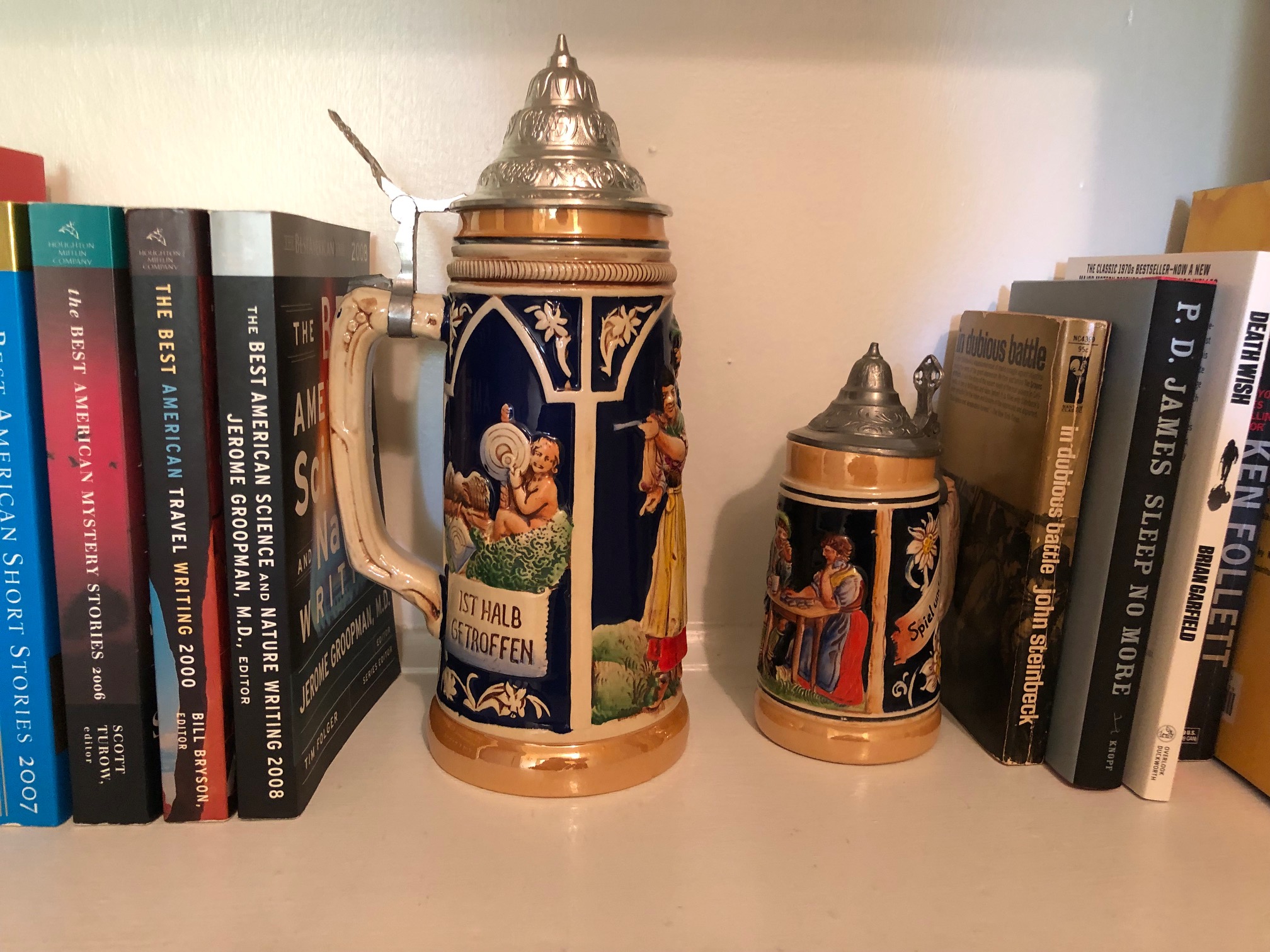
Except for the beer steins. I’m sure they’re worth something.   

I am such an idiot.

Spidey Senses

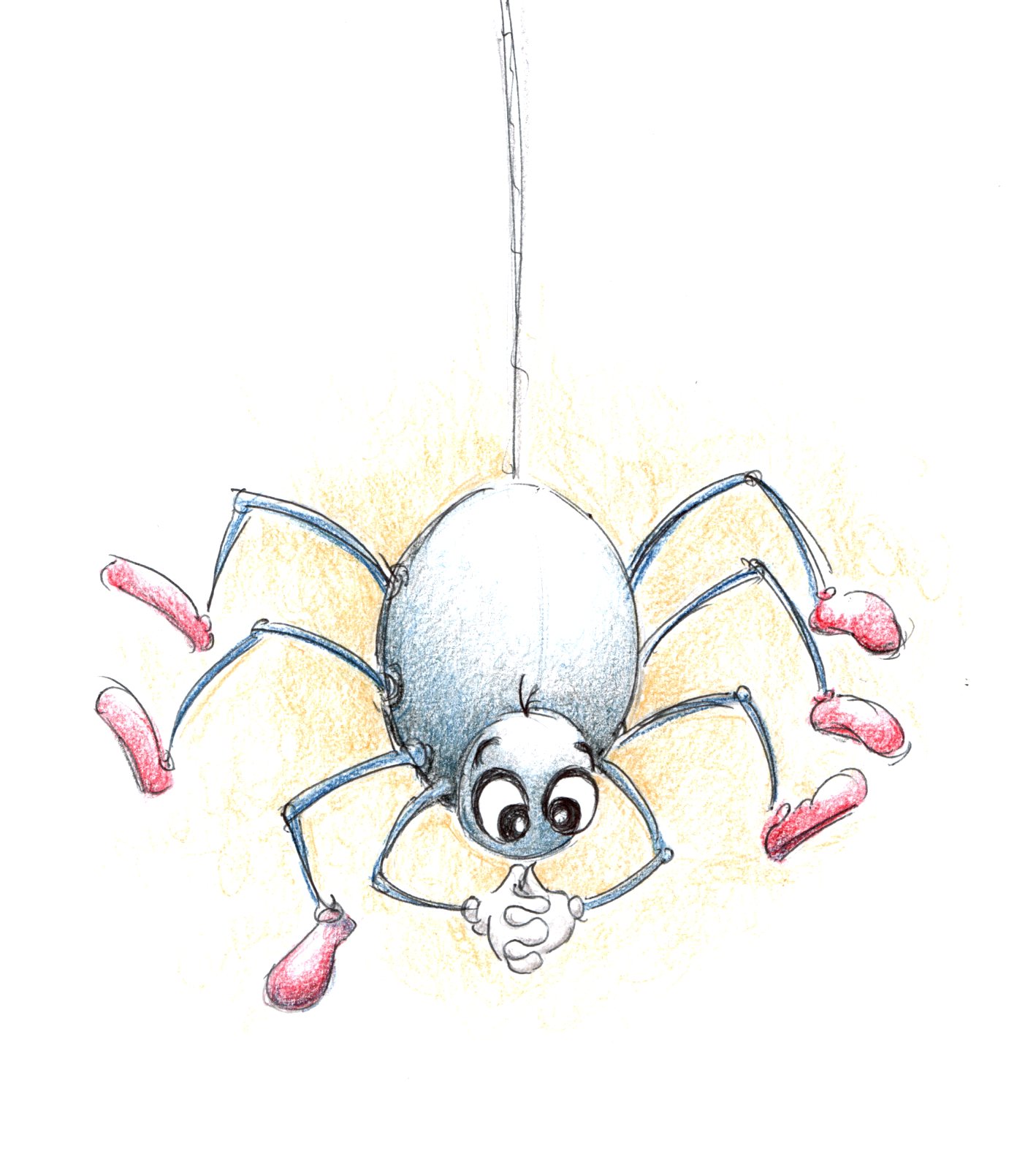
Have you ever looked at a spider close up? They’re cuter than you think.

Ever since I was a little kid, I had an agreement with the spiders in my room: “If I need to get a stepstool to kill you,” I told them. “Then I’m not gonna kill you.”

This was a very fair arrangement. The spiders had the entire ceiling and a perimeter of about two feet of upper wall space on which to putter about. The spiders had more navigable square footage in my room than I did. All they had to do was stay up there — and much to my surprise, that’s exactly what they did. I don’t know if spiders understand English or what, but they always kept out of reach, spending their days weaving web hammocks the size of industrial fishing nets.

I liked the webs. I was fascinated by them. Late at night when I was unable to sleep, I would sometimes flop on my back, turn on the reading lamp clamped to my headboard, and puff a lungful of air skyward to watch the webs dance in the breeze. It was a serene and pleasant way to wait for sleep to overtake me.

I liked my spiders.

Mom didn’t.

“Oh, my GOD, what is going on up there?” she announced one Saturday morning.

Saturday was cleaning day in the Allegra house. Every week without fail Mom would scrub the house from top to bottom. The only room she didn’t scrub was mine. That was my job. She might sometimes check to make sure I didn’t shirk this responsibility, but she didn’t have to worry about me much. I was a tidy kid and she knew it, so her snap inspections were largely ceremonial. She’d only glance to make sure the carpet was lint free and the bureaus wore a lemon-scented Pledge shine.

Until that day she looked up.

“Why didn’t you tell me you had all these webs up there?!”

When Mom took this kind of tone with me, my first instinct was to play dumb. “Hm?” I looked up and feigned surprise. “Oh. I… I never noticed.”

“Never noticed? You spend all day every day farting around in this room and you never, not once, looked up?”

“Uh…”

As usual, Mom’s BS detector struck me mute.

“There’s more web than ceiling!”

Without another word she tromped down the hall, off to get her canister vacuum. Mom’s vacuum was an amazing machine. I have no idea where she had bought it, but it was a weapons grade force of nature, loud as a Harley and armed with enough suction to rip a hole in the fabric of space and time. Like Excalibur or Thor’s Hammer, I always had the sense that Mom was the only person on earth capable of wielding it.

And wield it she did. In an instant, the spiders with whom I had shared such a cordial cohabitation were sucked into oblivion.

I wasn’t exactly sad to see the spiders meet this fate — they weren’t my friends or anything — but I’d be lying if I didn’t say that it all felt terribly unfair.

Now I’m a homeowner. Mom and her vacuum no longer hold sway over my life. But my views on spiders have hardened over the years. I kill them now. Often and with extreme prejudice.

I don’t exactly know when or how I changed. Maybe it has something to do with me getting older and crankier. Maybe it’s because I am no longer charmed by the entertainment value of a web hanging over my bed. Or maybe it’s because — like my Mom before me — I do most of the housecleaning. Those webs really do make a house look filthy, don’t they?

But that’s a pretty shallow reason to commit murder, really.

Maybe someday my views will shift back to where they once were. My eyes are getting worse; maybe the webs won’t bother me so much if I can no longer see them so well. Maybe I will rediscover my childlike sense of wonder. Or maybe, with a little work and a little patience, I can learn to follow the philosophy of Live and Let Live.

It’s a nice thought.

But in the meantime, spiders take note: I have a stepstool and I’m prepared to use it.