Doodle Do

superfly

When I was nine I decided to have a heart-to-heart conversation with my mother.

“I want to know how to draw,” I told her.

“You can draw. You draw all the time,” she replied.

“No. I want to know how to really draw,” I said. And Mom understood.

What I had been doing up to this point was filling one sketchbook after another with silly doodles – and, well, I was sick of it. My age was almost in the double digits. It was time to move to the next level. So I wanted Mom’s help (and Mom’s money) to become a real artist and create real things that looked really real.

Mom was very supportive of such things. She signed me up for lessons and, for the next eight years, I created some nice stuff. By the time I was 18, I was skilled in charcoal, watercolor, colored pencil, and oil – and was contemplating a career as a graphic designer. I assembled a portfolio good enough to get accepted into a design program at an excellent college.

Shortly after I unpacked my stuff in the freshman dorm, however, I discovered that I was sick of art. I’m not sure why this epiphany happened right after I paid my tuition bill, but it did; my new passion for playwriting had smothered the visual arts part of my brain.
pet peeve

I am a “finish what you start” kinda guy. That is to say, I am the kinda guy who understands that virtually nobody can earn a living as a playwright. I needed a fallback career, so I continued to stumble down the design path. I sleepwalked through my classes, rushed my studio projects, and hoped the professors would be in a generous enough mood to give me a low B. OK, a C was fine, too. Whatever. As long as I had time to write.

After I graduated, I worked as a designer for four years and life was very much the way it was when I was in college: My interest in design was half-hearted and my interest in playwriting nearly obsessive.

I got fired a lot.

Eventually I left design behind for good and found ways to write full time. What a relief that was. No more visual art. Occasionally, a family member (Dad) would ask why I don’t paint anymore.

“You were so good!” he’d say. Then he’d lead me to a wall. “Come here. Look at this painting you did. Isn’t it great?”

“You’re asking me to brag about my own stuff?” I’d ask.

“You should brag. Look at it!”

“Art no longer interests me,” I explained.

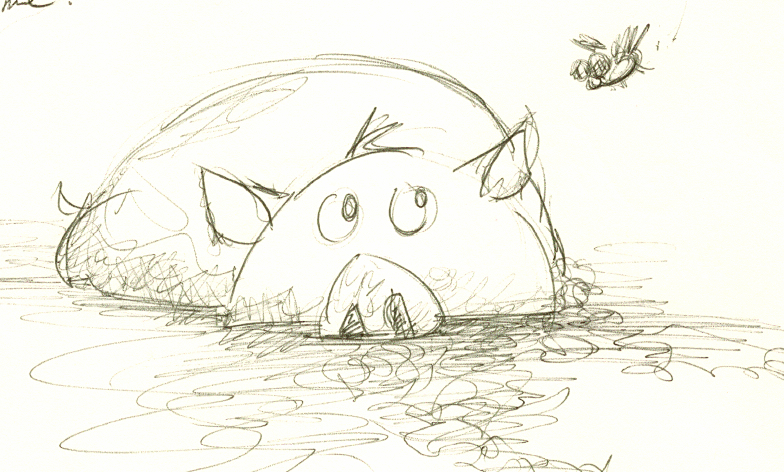
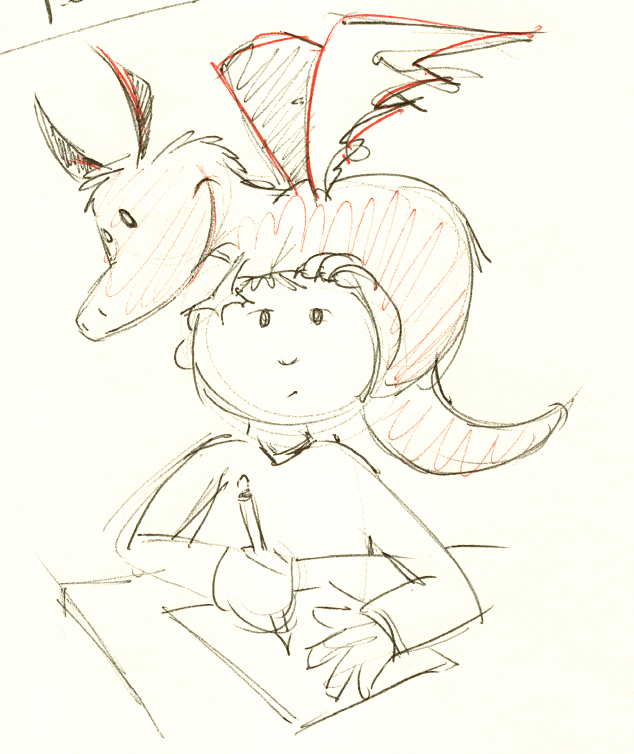
That, I discovered, was only half true. No, I have not touched watercolor paper or a canvas since college, but ever since I started writing for children, my zeal for doodling has returned with a vengeance. Thank goodness for that; I found that doodling can be an important tool for the children’s book writer.

Doodling is great way to take a break from a story without really taking a break from a story. When I’m stuck or need a little motivation, I’ll often turn away from the computer and draw a character or a scene from the story I’m trying to tell. This helps me keep my mind on the task at hand. But since I’m exercising a different part of my brain, it’s refreshing, too. I’m working and taking a break at the same time. That’s multitasking!

I also recently noticed that doodling is a great way to generate new ideas – which turned out to be invaluable last November when I participated in my first Picture Book Idea Month (PiBoIdMo). Without giving too much thought to what I was doing, I filled up one sketchbook after another with weird characters and situations. Many of the drawings were just plain awful, but they suggested stories I never would’ve come up with had I relied solely on putting words on a page.

To put it another way, I found inspiration by becoming nine again.

Ta Daa!

My Pest Friend

I don’t have a Best Friend. I don’t yearn for one, either.

I do, however, have a Pest Friend – and he is a treasure.

Pest Friends, if you need a definition, are friends who harass you into doing things you don’t want to do but know you should do. In their irksome, persistent way, they (metaphorically) make you eat your vegetables.

I’ve known My Pest Friend — also named Mike — since we were undergrads at Carnegie Mellon University. He and I first met in a playwriting class and the roots of our friendship began to grow once we admitted that we found each other’s scripts funny. This is about as good a way to begin a friendship as any. In fact, it is possibly the best way.

At that time I was taking playwriting very seriously. I wasn’t a good playwright, not even close, but I was serious. In fact, I shunned a number of social opportunities to read every last play that could be found in Hunt Library’s extensive collection. And when I wasn’t reading, I was writing. Not only did that allow me to hone my skills, but it also allowed me to indulge my Sullen Loner instincts.

Mike was different. He did not take playwriting seriously. He also was more of social animal than I. But he, too, exploited any free moment he had to pursue his passion – musical composition – with a rigor that equaled and perhaps even surpassed my own.

After graduation we continued our pursuits. Mike moved to L.A. and became a composer of some renown, and I went back to New Jersey where, by some kind of miracle, I learned how to make a decent living as a writer and editor.

Both of our passions evolved over time. I shifted from playwriting to children’s books. Mike, in addition to scoring movies and video games, began to drift into musical theatre. His drift in that direction, however, was slow, almost glacial. By the time he was fully committed to the idea of writing for the stage, I was no longer there to welcome him. Theatre didn’t interest me much anymore.

My actions, I’m afraid, vexed Mike. From that day to this, Mike became my Pest Friend.

Mike used to live in New York so, once or twice a year, he heads to the East Coast to visit his family. Once he arrives, we set up a time to have lunch.

I always look forward to these lunches, but, I must admit, I dread them a little, too. For one thing, Mike does not have children – or, to put it another way, his mind is not addled. His intellect and wit are every bit as sharp as they were in college. I used to be able to keep up with Mike’s lightening quick conversational skills, but those days are long gone. My mind is now as sharp as a billiard ball, and the closest I can come to “witty” these days is when I trot out my impressive collection of poop-related humor.

I also kinda dread these lunches because I know where our conversation will eventually lead. Mike will pester me into writing a short play.

First he softens me up. Mike always was one of my biggest fans, and he goes on for a bit about how I’m turning my back on my natural talents. This flatters me because I know he is sincere.

Mike then observes that a 10-minute play does not require a major time commitment. Which is true.

Mike then points out that online theatre databases make it easy for me to find acting companies that would produce my stuff. Which is also true.

Mike then reminds me that there is no financial outlay. This, too, is true. Unlike the old days, I can submit my scripts via email (so no snail mail costs). I also no longer need to pay dues to The Dramatist Guild.

“And you make money, don’t you?” he asks me.

Indeed I do. Usually, anyway.

Oh, I try to negotiate with Mike as he works me over. “Tell ya what,” I say. “I’ll write a new play as soon as you marry that girlfriend of yours. And, to sweeten the deal, I’ll write a full-length script as soon as you two have a baby.”

But these counteroffers roll off Mike like water off a duck’s butt. He knows they are just the ravings of a man who has already lost.

He also knows that I would never lose if I didn’t, somewhere deep down, want to lose.

“Writing for kids is great and you’re good at it,” he says to me telepathically. “But you, Allegra, need to write for grown-ups once in a while. Poop humor is fine, but your sense of humor used to make people bleed. You miss it.”

And, ugh, that’s true, too. Damn that Mike and his razor sharp brain!

Long story short, I’m writing another short play and Mike is the pestiest pest I know.

And, well, I don’t think I’d want it any other way. Thanks, buddy.

An Intervention for the Literary Lothario

Setting: A bar. MIKE and the LITERARY LOTHARIO sit at a table. MIKE drinks a hard cider. The LITERARY LOTHARIO is downing something a bit more potent. MIKE eyes him with disapproval.

MIKE

I can’t believe what I’m hearing, buddy. A few months ago you couldn’t stop talking about your Novel. It was as if there was nothing else in the world. You couldn’t stop telling me how beautiful she was, how unique she was. You loved the cute way she wrapped up her first act and how her characters were so well-rounded. And then you went on and on about her story construction! I thought I was gonna have to hose you down.

You knew she was special. You always carved out time to be with her. And when you couldn’t be with her, you thought about her.

So what happened, man?

You know what happened? I’ll tell you what happened. It happens in every relationship. You’re halfway through the first draft. You moved past the dreamy, infatuation stage, and you started to notice that your Novel wasn’t as perfect as you thought she was.

And now you’re starting to ask yourself questions:

“Did she always have that plot hole?”

“Was that well-rounded character I loved so much always just a loose assembly of quirky traits?”

And now you’re starting to think, “Why is this relationship requiring so much work?”

You wanna know the answer to that last one? Because all relationships require work.

And now that things have gotten a little more real, now that the glow has faded a little, you’re starting to stray.

You don’t think I see your eyes wander? I heard about you and that novella. Don’t even bother denying it. And just the other day I spotted you canoodling with some free verse. What are you, 17? Grow up! God only know what you can catch from such a loose and unrestrained form of writing!

You have a beautiful Novel at home and you’re out cruising for new stories. Do you think that’s the way to strengthen a relationship? Do you think that’s the way to be happy? And don’t even pretend that this is her fault. You’re screwing this all up, not her.

(Pause. MIKE sighs.)

Let me tell you something, bucko. In the long run this behavior will leave you empty inside. You’ll look back on a life full of empty flings and false starts and wonder why you don’t have a fully-realized Novel to call your own.

You were in love, man! IN LOVE! You and your Novel were the perfect pair. Don’t walk away from that.

Go home, dummy. Work on that Novel of yours. Rekindle that spark. ‘Cause let me tell you something. If you don’t take good care of her, I will. You get me?

(The LITERARY LOTHARIO exits, leaving his drink half finished. MIKE nods and smiles.)

Attaboy.

(MIKE finishes off his cider and waves for another round as the lights fade.)