Repost: Fluffernonsense

In the first few months of this blog’s existence, I was pretty much talking to myself. I didn’t mind this, exactly, for I was still experimenting. But I was, I admit, a wee bit lonely.

This post from April 2012, in its tiny way, got things off the ground for me. After it went live, readers started visiting my blog. More importantly, they stuck around to see what I would say next. 

Wanna know my secret to building a modest online following? Two words: “Monkey Poo.” 

You’re welcome.

***

Some monkeys try to type Hamlet, others make this.
Yummers.

The other day I was hunched over the breakfast table so miserable, tired, and achy that I felt like I was recovering from a hangover. As I had not imbibed anything stronger than orange juice the night before, this all seemed horribly unfair. I could do little more than stare at my waffle, inhale my coffee, and hope that my head would stop throbbing. It was barely 7 a.m. and I had already chalked the day up as a loss.

Ellen and Alex were at the table, too. She was eating a Fluffernutter on a toasted English muffin. He was picking at dry cereal while suspiciously eying the Fluff jar. Alex loves marshmallows, but there’s something about Fluff that he doesn’t quite trust. He won’t go near the stuff.

After a long, silent pause, with each of us absorbed in his and her own private thoughts (My thought being, “I hate everything!”), Alex broke the silence with a question that oozed disgust: “Where does that come from?” he asked, pointing to the Fluff.

The words flew out of my mouth so quickly they surprised my brain.

“Fluff Monkeys,” I said.

“What?” Alex sputtered, eyes wide.

Then he said: “Noooooo. It does not. It does not.”

Then, a millisecond later: “Does it really? Really, daddy? Daddy. Daddy. Does it really?”

“It really does,” I said. “Fluff Monkeys live deep in the jungles of Borneo and explorers go there to look for them.” I wasn’t quite sure where I was going with this, so I sipped my coffee to buy time. It turned out I didn’t really need to do this; before I finished slurping, the rest of the tale came into focus. “When the explorers see a Fluff Monkey, they poke it with a stick to annoy it. Well, as you know, annoyed monkeys throw their poop. And that’s good, because Fluff Monkeys poop Fluff.”

To a six-year-old, there is no better punchline to any joke than “poop.” Alex was in giggle mode.

“So they poop the Fluff and throw it at the explorers. The explorers catch the poop and collect it in wheelbarrows,” I said. “Then the explorers wheel the poop away, put it in jars, and sell it to your mother.”

Ellen feigned the dry heaves. Alex leapt from his chair so he could literally fall on the floor laughing.

We had a few more laughs with the Fluff Monkey idea before we all wheezed a tired sigh and got back to eating. By then I was amazed to discover that my headache was gone.

Behold the healing power of nonsense!

What’s the most sublime bit of nonsense you had ever told another person?
Goldielockup Love

About a month ago, I entered a fractured fairy tale writing contest over at Susanna Leonard Hill’s place. My entry, Golidilockup, won second place, which made me giddy.

Now Susanna has another contest, this time for illustrators. Their assignment — if they choose to accept it — is to design a book cover for any of the winning entries.

The lovely Catherine Constance threw down the gauntlet and illustrated two of the winning stories: The Princess and the Stinky Cheese by my pal, Lauri Meyers, and — you guessed it — Goldilockup!

Woo!

So head on over and give Catherine some love, why don’cha?

Oh, and if you haven’t read Goldilockup yet, head over here.

UPDATE: Jumping Jehoshaphat! Other fine artists are giving Goldielockup love, too! Check out my Facebook page to see some other contest entries!


Doodle Do

superfly

When I was nine I decided to have a heart-to-heart conversation with my mother.

“I want to know how to draw,” I told her.

“You can draw. You draw all the time,” she replied.

“No. I want to know how to really draw,” I said. And Mom understood.

What I had been doing up to this point was filling one sketchbook after another with silly doodles – and, well, I was sick of it. My age was almost in the double digits. It was time to move to the next level. So I wanted Mom’s help (and Mom’s money) to become a real artist and create real things that looked really real.

Mom was very supportive of such things. She signed me up for lessons and, for the next eight years, I created some nice stuff. By the time I was 18, I was skilled in charcoal, watercolor, colored pencil, and oil – and was contemplating a career as a graphic designer. I assembled a portfolio good enough to get accepted into a design program at an excellent college.

Shortly after I unpacked my stuff in the freshman dorm, however, I discovered that I was sick of art. I’m not sure why this epiphany happened right after I paid my tuition bill, but it did; my new passion for playwriting had smothered the visual arts part of my brain.

pet peeve

I am a “finish what you start” kinda guy. That is to say, I am the kinda guy who understands that virtually nobody can earn a living as a playwright. I needed a fallback career, so I continued to stumble down the design path. I sleepwalked through my classes, rushed my studio projects, and hoped the professors would be in a generous enough mood to give me a low B. OK, a C was fine, too. Whatever. As long as I had time to write.

After I graduated, I worked as a designer for four years and life was very much the way it was when I was in college: My interest in design was half-hearted and my interest in playwriting nearly obsessive.

I got fired a lot.

Eventually I left design behind for good and found ways to write full time. What a relief that was. No more visual art. Occasionally, a family member (Dad) would ask why I don’t paint anymore.

“You were so good!” he’d say. Then he’d lead me to a wall. “Come here. Look at this painting you did. Isn’t it great?”

“You’re asking me to brag about my own stuff?” I’d ask.

“You should brag. Look at it!”

“Art no longer interests me,” I explained.

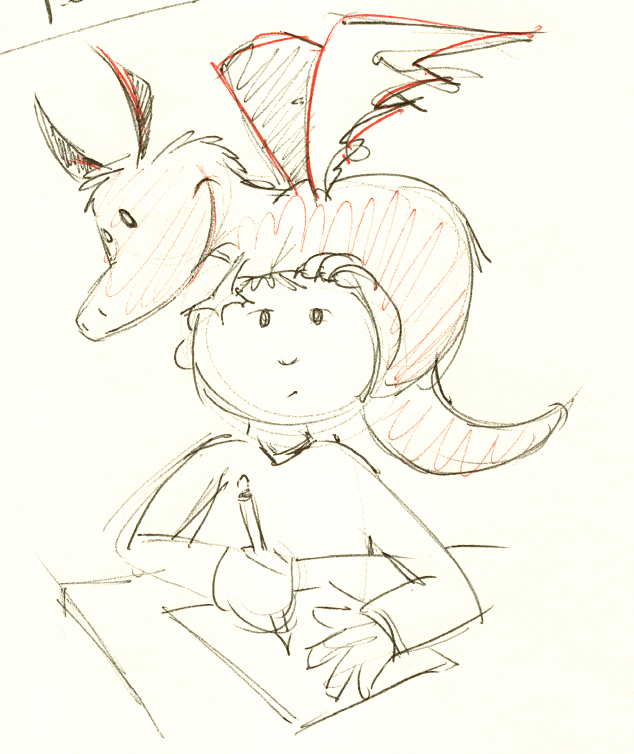
That, I discovered, was only half true. No, I have not touched watercolor paper or a canvas since college, but ever since I started writing for children, my zeal for doodling has returned with a vengeance. Thank goodness for that; I found that doodling can be an important tool for the children’s book writer.

Doodling is great way to take a break from a story without really taking a break from a story. When I’m stuck or need a little motivation, I’ll often turn away from the computer and draw a character or a scene from the story I’m trying to tell. This helps me keep my mind on the task at hand. But since I’m exercising a different part of my brain, it’s refreshing, too. I’m working and taking a break at the same time. That’s multitasking!

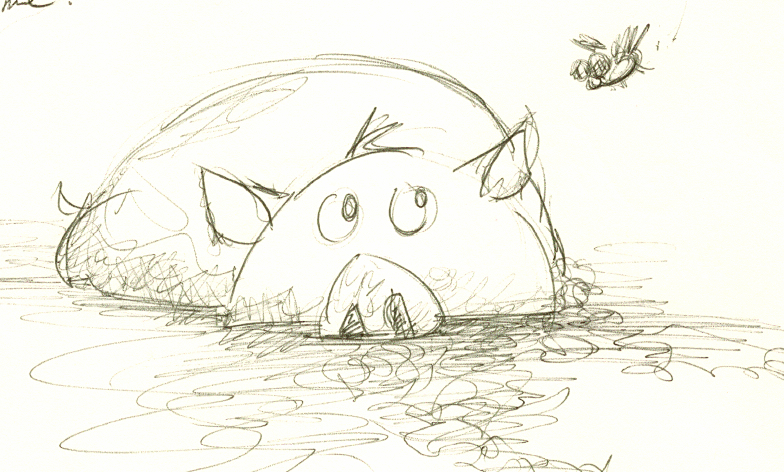
I also recently noticed that doodling is a great way to generate new ideas – which turned out to be invaluable last November when I participated in my first Picture Book Idea Month (PiBoIdMo). Without giving too much thought to what I was doing, I filled up one sketchbook after another with weird characters and situations. Many of the drawings were just plain awful, but they suggested stories I never would’ve come up with had I relied solely on putting words on a page.

To put it another way, I found inspiration by becoming nine again.

Ta Daa!